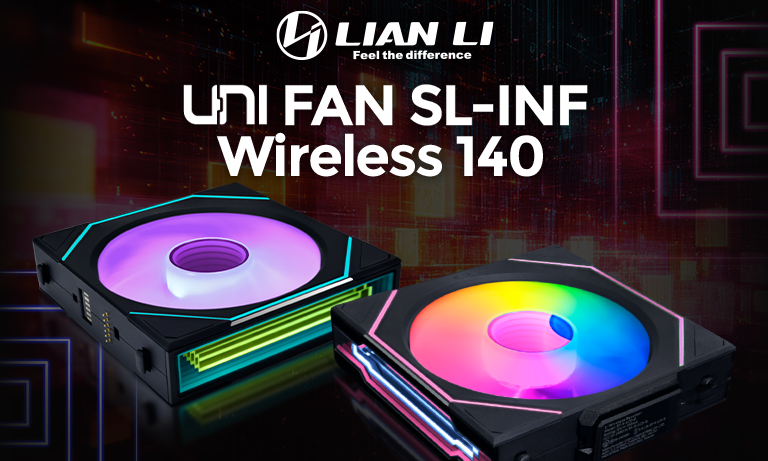
Design and visual appearance
The Lian Li UNI FAN SL-INF Wireless 140 clearly represents the direction of visually impressive yet thoughtfully designed fan hardware. The model continues the well-known infinity mirror look of the SL-INF series, but now adds a wireless control concept to it. The fan uses three separate lighting zones: an illuminated center section, side diffuser strips and a lighting effect that runs along the inner frame, resulting in a far more layered appearance than a typical ARGB fan. According to the manufacturer, the 140 mm version uses 62 LEDs, which already signals that the visual side is at least as important here as cooling performance.
The frame also offers two different side designs, meaning the final build can take on a different character depending on the fan’s orientation. At first glance this may seem like a minor detail, but in a glass-panel case built with visual impact in mind it can make a real difference. The overall look is further strengthened by the usual UNI FAN interlocking system, where fans connected to one another create a much cleaner interior than separately wired solutions.
The frame also offers two different side designs, meaning the final build can take on a different character depending on the fan’s orientation. At first glance this may seem like a minor detail, but in a glass-panel case built with visual impact in mind it can make a real difference. The overall look is further strengthened by the usual UNI FAN interlocking system, where fans connected to one another create a much cleaner interior than separately wired solutions.

Technical specifications and cooling performance
The standard 140 mm version measures 142 × 140 × 28 mm, so the frame is thicker than conventional 25 mm models. This design is interesting partly from a performance standpoint and partly because of the lighting system. The standard airflow version operates between 200 and 1800 RPM, with up to 77.6 CFM airflow, 3.45 mmH₂O static pressure and 27.7 dBA noise level. The reverse blade version works in a 200–1700 RPM range, with 73.8 CFM airflow and 3.12 mmH₂O static pressure. These numbers show that the model was designed not just as a visual fan, but as a solution suitable for real cooling tasks as well.
The bearing system is FDB, or Fluid Dynamic Bearing, which is the long-term oriented solution expected in this category. Lian Li also specifically highlights that the fan is intended to work well with radiators and cases with denser front panels, which is a realistic claim based on the static pressure figures. The advantage of the 140 mm format shows clearly here: even with a larger blade surface, noise levels can remain well controlled, making it an interesting option for both case airflow and water-cooling radiators.
The bearing system is FDB, or Fluid Dynamic Bearing, which is the long-term oriented solution expected in this category. Lian Li also specifically highlights that the fan is intended to work well with radiators and cases with denser front panels, which is a realistic claim based on the static pressure figures. The advantage of the 140 mm format shows clearly here: even with a larger blade surface, noise levels can remain well controlled, making it an interesting option for both case airflow and water-cooling radiators.

Wireless control and installation advantages
One of the most important innovations of the SL-INF Wireless series is that fan speed and lighting are controlled wirelessly through the L-Wireless Sync system and the L-Connect 3 software. Lian Li’s solution does not mean the fan uses no cable at all, but rather that traditional separate control and RGB cabling is significantly simplified. A receiver unit connects to the fan group, and the system can manage up to 10 separate device groups through a single controller. In practice, this results in a much cleaner interior and simpler cable management.
The fan still includes 4-pin PWM power and BIOS detection, so it does not function as an isolated ecosystem, but can be integrated into the system in a normal way. The quick-connect PIN system and daisy-chain layout are especially useful when using multiple fans, as each unit does not need to be wired separately. One important detail is that the 140 mm model is only available as a single-pack version, and the controller is not included automatically, so it must be purchased separately unless the user already has a compatible L-Wireless controller.
The fan still includes 4-pin PWM power and BIOS detection, so it does not function as an isolated ecosystem, but can be integrated into the system in a normal way. The quick-connect PIN system and daisy-chain layout are especially useful when using multiple fans, as each unit does not need to be wired separately. One important detail is that the 140 mm model is only available as a single-pack version, and the controller is not included automatically, so it must be purchased separately unless the user already has a compatible L-Wireless controller.

Standard and reverse blade versions
Lian Li offers the 140 mm SL-INF Wireless model in both standard and reverse blade versions, in black and white. This matters because in many visually focused builds it makes a real difference which side of the fan faces inward in the case. The reverse blade version allows the more attractive, lighting-optimized side to remain visible even when the fan is used as intake. This approach has become increasingly popular in premium builds recently, and Lian Li makes effective use of that demand here as well.
There is not only a difference in blade direction between the two versions, but also a small variation in performance figures. The standard version offers slightly higher speed, airflow and static pressure, while the reverse blade model gives more freedom for appearance-focused layouts. Because of this, the decision is not only about how much air the fan moves, but also about how the finished configuration will look inside the chosen case.
There is not only a difference in blade direction between the two versions, but also a small variation in performance figures. The standard version offers slightly higher speed, airflow and static pressure, while the reverse blade model gives more freedom for appearance-focused layouts. Because of this, the decision is not only about how much air the fan moves, but also about how the finished configuration will look inside the chosen case.
Summary
The Lian Li UNI FAN SL-INF Wireless 140 shows clearly where the premium fan segment is heading. The focus is no longer only on airflow and lighting, but also on how cleanly and logically a complete system can be built around the product. The wireless control concept, interlocking design, triple-zone ARGB appearance and solid cooling figures all come together in a distinctly modern product.
It will be especially appealing to users building a glass-panel, visually focused configuration who do not want fan cabling to disrupt the overall look. Thanks to the 140 mm format, it is also a serious option for both case cooling and radiator use, while the standard and reverse blade versions make it easier to tailor the final appearance to the specific build.
It will be especially appealing to users building a glass-panel, visually focused configuration who do not want fan cabling to disrupt the overall look. Thanks to the 140 mm format, it is also a serious option for both case cooling and radiator use, while the standard and reverse blade versions make it easier to tailor the final appearance to the specific build.


